Key takeaways
- Broth is your product and your biggest food safety risk. Plan how you will cool and store large batches.
- Buy noodles from a supplier, or make them in-house for your own shop. Supplying other outlets needs a Food Processing Establishment licence.
- Counter seating and kiosk ordering suit a fast single-dish menu with quick table turns.
- Toppings and noodle firmness are modifiers. Set them up so they print clearly for the kitchen.
- Cost a bowl from broth per litre, noodles, tare, toppings and packaging.
This guide is general information, not legal advice. Official rules and fees quoted come from the SFA, SCDF and MOM pages linked below, checked on 28 September 2026. Confirm the current position with each agency before you sign a lease.
Ramen shops work differently from a full Japanese restaurant. There is one core dish, a small menu of sides, fast turns and a kitchen built around stock pots and noodle boilers. If you are planning sushi, omakase or a broad izakaya menu, start with our Japanese restaurant guide, which covers raw fish safety, sake licensing and hiring Japanese chefs. This article focuses on what makes a ramen shop different.
Choose your ramen concept
| Concept | What it means for operations |
|---|---|
| Tonkotsu (pork bone) | Long boils, heavy stock pots, strong smells; needs good exhaust and cooling |
| Chicken paitan or shio | Shorter cooking times; lighter broth; easier to batch |
| Shoyu or miso | Tare-driven; the base stock can be simpler |
| Tsukemen (dipping) | Thick, concentrated broth; noodles served chilled or at room temperature |
| Vegetarian or halal-friendly | Separate stock, utensils and possibly suppliers |
Pick one lead broth and do it well. A second broth doubles your stock pots, storage and cooling work.
Licences and premises
SFA’s fees page lists the Food Shop Licence at $195 a year and the Food Stall Licence at $32 a year. You apply on GoBusiness with a scaled layout plan, SFA reviews complete applications within 7 working days, and you renovate only after approval. SFA’s requirements page says food handlers must meet the WSQ Food Safety Course Level 1 requirement at the point of application. A food court or coffee shop stall is the lower-cost route; a shop unit gives you counter seating and your own brand space. Our noodle stall guide covers the stall route.
Long-boiling stock produces steam, heat and smell. SCDF’s Fire Code clause 7.1.13 says the cooking exhaust must be independent of other systems and discharge directly outside, at least 5m from any air intake, with a 500mm clearance from unprotected combustible materials around the hood and ducts. Check the unit’s exhaust, gas supply and floor loading for heavy stock pots before you sign.
Broth production and food safety
Broth is made in large volumes and held for hours, which is exactly the risk SFA warns about. SFA’s temperature control page says Clostridium perfringens grows well in protein-rich dishes cooked in large quantities, such as stews and meat gravy, and that food not for immediate use should be refrigerated at 4°C or lower or kept at 60°C or higher. SFA’s December 2024 advisory says to divide large amounts into smaller portions for quicker cooling and not to keep ready-to-eat food between 5°C and 60°C for more than 4 hours.
- Hold hot. Keep service broth at 60°C or above through the day.
- Cool fast. Split leftover broth into shallow containers and use an ice bath or blast chiller before refrigerating.
- Label. Date and time every batch, and use the oldest first.
- Chashu and eggs. Chill marinated eggs and sliced chashu promptly and keep them cold until service.
If you import pork bones or chashu cuts directly, SFA’s import requirements page says meat must come only from SFA-approved sources with health certificates. SFA’s import fees page lists the meat and fish products licence at $84 a year and the registration to import processed foods, such as tare ingredients and dried goods, as free.
Noodle sourcing: buy or make?
Noodles make or break a bowl. Your options:
- Local noodle manufacturers. Many make ramen noodles to a spec: thickness, water content and kansui level. Ask for samples and test them in your broth.
- Imported noodles. Frozen or fresh noodles from Japan through an importer. Check lead times and freezer space.
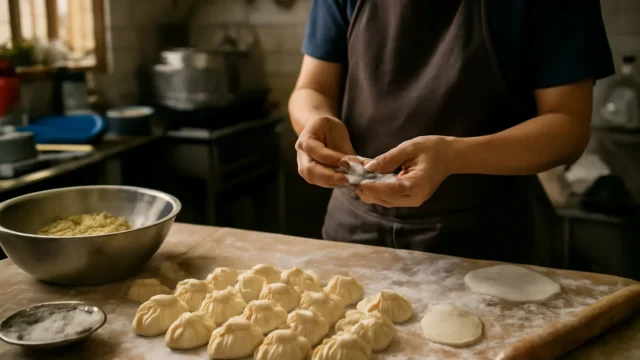
- In-house. A noodle machine gives control and a story, but adds labour and space. SFA’s manufacturing licence page lists noodle and pasta manufacturers among businesses that need a Food Processing Establishment licence when supplying wholesalers and retailers. Making noodles only for your own shop is a different case; ask SFA how your set-up is treated.
Whatever you choose, agree the spec in writing and keep a backup supplier. Wheat and egg are among SFA’s 8 most common allergens, and soy sauce tare adds soya; show this on the menu.
Counter seating and flow
Counter seating is the classic ramen layout for a reason: solo diners fill single seats, guests eat quickly and staff can serve from behind the counter. Plan:
- Counter depth for a bowl, a tray and condiments.
- Pass position so bowls go from the noodle boiler to the guest in seconds.
- A few tables for groups and families.
- Waiting space outside or inside; a queue system helps at peak.
Our guide to seating layouts covers spacing, and our guide to table turnover shows how to measure it.
Ticket machine or self-order kiosk?
Many ramen shops in Japan use ticket machines: guests pay first and hand over a ticket. In Singapore, a self-order kiosk does the same job with more flexibility:
- Guests choose broth, noodle firmness, spice level and toppings on screen, with photos.
- Payment happens at the kiosk, so staff do not handle cash at the counter.
- Orders go straight to the kitchen, with each modifier printed or shown clearly.
- Upsell prompts for extra chashu, eggs, gyoza and drinks are easy to add.
Our comparison of the best self-order kiosks in Singapore covers options and costs, and our kiosk menu design guide covers layout. QR ordering at the counter is another option; see our QR vs kiosk vs counter guide.
Toppings and modifiers
Ramen orders are built from options. Set them up as modifier groups:
- Required: broth (if more than one), noodle firmness.
- Optional: richness, spice level, garlic, extra noodles (kaedama).
- Paid add-ons: extra chashu, ajitama egg, corn, butter, nori, bamboo shoots.
- Remove: no spring onion, no bean sprouts.
Keep the list short enough that the kitchen can read a ticket at a glance. Our guide to menu modifiers explains required and optional groups, pricing and limits. Kaedama (a second serving of noodles) is a useful upsell for counter shops: guests order it mid-meal, so make it a quick item on the POS.
Costing a bowl
Cost a bowl from its parts: broth per serving (the total cost of a batch divided by the servings it yields), noodles per portion, tare, oil, toppings, garnish and packaging for takeaway. Tonkotsu broth uses large amounts of bones and gas, so include fuel in the batch cost. Our recipe costing template and portion control guide show the method. If you plan to hire Work Permit holders, MOM’s services sector page says restaurants qualify but food stalls and hawker stalls do not, and the quota is 35% of your workforce.
POS setup for a ramen shop
With ChaChaCha’s restaurant POS, powered by AppsPOS:
- Self-order kiosk. A kiosk with a built-in card terminal takes orders and payment in one step.
- Custom modifiers. Broth, firmness, toppings and removals on every order, with tickets in English or Chinese.
- Kitchen display. The kitchen display system routes bowls and sides to the right station, with prep timers and order prioritisation.
- Queue. A queue system with SMS notifications and a digital queue display for peak times.
- Stock. Recipe-level stock deduction and recipe costing per bowl.
- Payments and delivery. PayNow, PayLah!, NETS, Visa/Mastercard and GrabPay; GrabFood integration for delivery.
Pricing is quote-based. AppsPOS is approved under the EDGE Grant; see our grant guide. Want to see kiosk ordering with topping modifiers? Talk to us for a demo and a quote.