Key takeaways
- SFA lists bakeries under the Food Shop Licence when you sell to consumers from your own shop. SFA states that licence costs $195 and is valid for one year.
- If you supply your other outlets, cafés or other food businesses, SFA treats you as a food processing establishment (like a central kitchen) and you need a different licence with its own siting rules, fees and inspection.
- Home-based bakers do not need an SFA licence today, but they cannot sell to cafés or other food retailers, and URA’s scheme bans non-resident employees and non-domestic heavy equipment.
- Bread sold loose in a bakery shop is not “prepacked”, but anything you wrap in advance for sale must meet SFA’s labelling rules, including allergens.
- Pre-orders, deposits and daily wastage are what make or break bakery margins. Set up your POS to track both from day one.
This guide is general information, not legal advice. The general steps for any food shop (ACRA registration, checking a unit’s approved use, SFA layout plans, SCDF, hiring and GST) are covered in our guide to opening a café, and kitchen infrastructure such as grease traps is in our restaurant guide. Here we focus on what is different for a bakery.
Pick your bakery model first
Before you look at units or ovens, decide how your bakes will reach customers. The model decides your licence, the kind of premises you can use and how much equipment you need. Most bakeries in Singapore fall into one of four models:
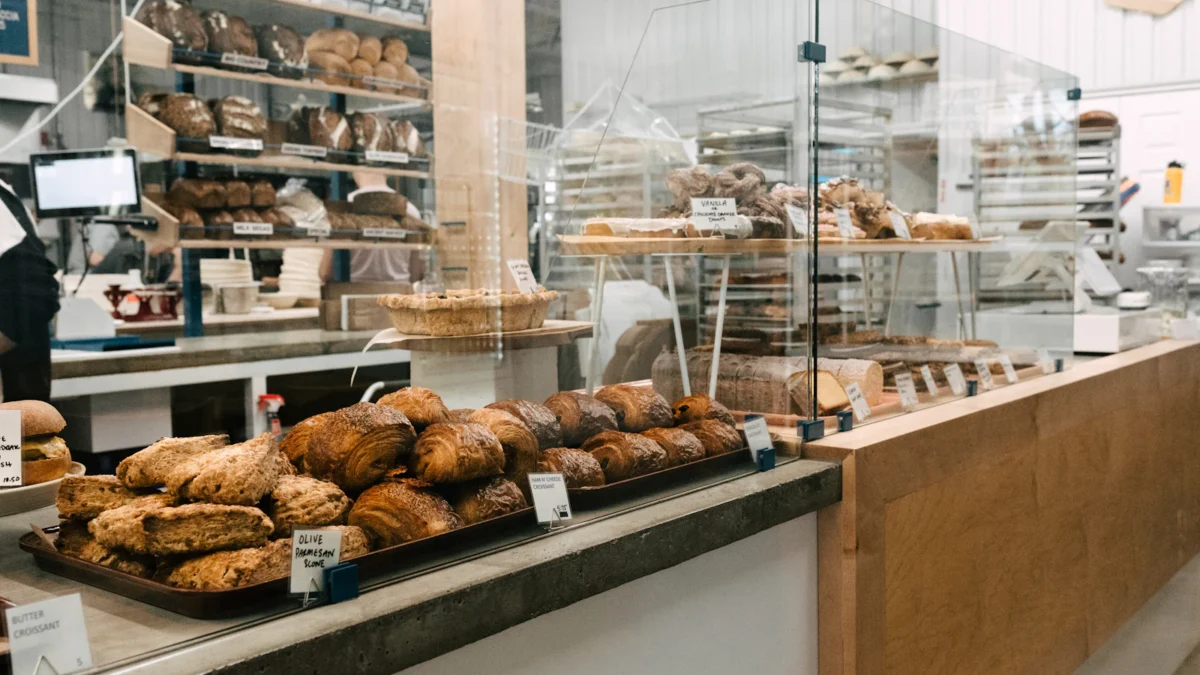
- Retail bakery with an on-site kitchen. You bake and sell from the same shop, often with a few seats and coffee. This is the classic neighbourhood or mall bakery.
- Central kitchen supplying outlets. One production kitchen bakes for several of your own shops or kiosks, which then only finish, display and sell.
- Wholesale bakery. You bake for cafés, restaurants, hotels or supermarkets. Your customers are other businesses.
- Home-based baker. You bake in your own flat or house and sell through pre-orders, social media and collection or delivery.
Many bakeries mix models over time. A home baker opens a shop; a shop starts supplying a café down the road; a two-outlet chain moves production into a central kitchen. Each shift can change your licensing, so plan ahead rather than finding out after you have signed a lease.
Which SFA licence does a bakery need?
Selling to consumers: Food Shop Licence
SFA’s requirements for food retail licences say plainly that “Food Shops include bakeries, restaurants, food vending machines, canteens, coffee shops” and similar premises. A bakery that bakes on site and sells to walk-in customers therefore applies for the Food Shop Licence on GoBusiness. SFA’s application process page lists it at $195, valid for one year, with complete applications reviewed within 7 working days. You submit a layout plan, renovate to the approved layout, then pass a pre-licensing inspection. The café guide walks through those steps in detail.
Supplying other outlets or businesses: Food Processing Establishment licence
This is where bakeries often get caught out. SFA’s page on businesses that need a licence for food manufacturing and storage states that food retail businesses “are only permitted to sell their food or food products to consumers”. It goes on: businesses that “sell or supply food and food products to their other outlets or other food businesses are considered a food processing establishment, such as a central kitchen”, and need a Licence to Operate a Food Processing Establishment. SFA’s own examples of food processing establishments include “flour confectionery factories” and “central kitchens”.
So if your bakery kitchen sends croissants to your second outlet, or sells loaves wholesale to a café, check with SFA whether you need this licence. According to SFA’s fees page for food manufacturing and storage:
- There is an application fee of $147.20, which covers evaluation of layout plans and process flow charts and a joint site inspection.
- The annual licence fee for an “other processed food” establishment is $180 below 200 m², $360 for 200 to 750 m², and $600 above 750 m². Licences are valid for one year.
- SFA reviews applications within 30 working days and checks, among other things, that the premises are designed for one-directional flow from raw materials to finished products.
- After in-principle approval you renovate, then SFA carries out a physical final inspection. You submit a cleaning and sanitation programme and a pest control contract at that stage.
Location matters too. SFA’s requirements page says food processing establishments “should be located within a food zone area or an area with compatible industrial uses”. Outside those areas, SFA assesses the site and may need clearance from JTC or URA and from NEA. In practice, a central kitchen usually sits in an industrial or food-zone building, not a mall unit. You apply on GoBusiness.
Food handlers
Under both licence types, food handlers need WSQ Food Safety Course Level 1. SFA’s food handler requirements set out the training and refresher rules, and our restaurant guide covers food hygiene officers.
Home-based baking: what is allowed
Plenty of Singapore bakeries started in a home kitchen. The rules are lighter, but they are real.
- No SFA licence, but food law still applies. SFA’s home-based food business page says these businesses “currently do not require an SFA licence to operate”, but they must still comply with food safety laws, use ingredients from legal sources and follow good hygiene practices.
- You cannot sell to food retailers. SFA states that licensed food businesses may only sell food prepared on their licensed premises or obtained from other licensed businesses. They cannot buy from home-based businesses. So a home baker cannot supply cakes to a café, and SFA also says home-based businesses cannot prepare food at home for temporary fairs.
- Scheme conditions on the premises. URA’s Home-Based Business Scheme requires the business to be run by the owners, registered occupants or tenants (with the owner’s consent), with no non-resident employees, no signage at the home, no heavy equipment or appliances not intended for domestic use, and no large-scale storage or frequent loading of goods. SFA’s page on the scheme points HDB residents to HDB’s own Home-Based Business Scheme, so check HDB’s conditions if you live in a flat.
The equipment rule is the practical ceiling for many home bakers. Once you need a deck oven, a spiral mixer or staff who do not live with you, you have outgrown the home and need licensed premises.
Finding premises for a bakery
A retail bakery needs a unit approved for food use, like any food shop. Check the approved use and the landlord’s fit-out rules before signing, as explained in the café guide. Bakery-specific questions to ask:
- Power. Electric deck and convection ovens draw a lot of power. Confirm the unit’s electrical load with the landlord and your contractor before you choose ovens.
- Gas and exhaust. Gas ovens need a gas supply and suitable ventilation. Ask whether the unit has an exhaust riser and what the landlord allows.
- Floor loading and space. Racks, proofers and large ovens are heavy and bulky. Walk the delivery route from the loading bay to the kitchen door.
- Display frontage. Bakeries sell with their eyes. A good shopfront with room for display cases often earns more than a larger kitchen.
- Early hours. Bakers start early. Check whether the mall or building allows access and deliveries before opening hours.
Equipment: what a bakery typically needs
Equipment depends on your menu and volume. We don’t quote prices here; get written quotes from two or three suppliers for each item and ask about warranty and local servicing. Typical categories:
| Category | Examples | What to check |
|---|---|---|
| Ovens | Deck oven for bread, convection or combi oven for pastries and cakes | Power or gas supply, capacity per bake, recovery time between batches |
| Mixers | Spiral mixer for dough, planetary mixer for batters and creams | Bowl size against your batch size; noise and floor space |
| Proofing and retarding | Proofer, retarder or dough fridge | Lets you prepare dough the day before and bake early |
| Dough handling | Sheeter for laminated pastry, divider or rounder for bread | Only worth it at volume; many start without |
| Cold storage | Chillers, freezers, blast chiller | Separate raw and finished goods; room for cream cakes |
| Front of house | Display cases (ambient and chilled), bread racks, packaging station | Chilled display for cream-filled items |
| Hygiene | Sinks, wash basins, stainless tables | Must match the layout plan you submit to SFA |
| Counter tech | POS, payment terminal, receipt and label printer | Plan power and network points during renovation |
Second-hand ovens and mixers can protect cash in the first year, but check the condition and whether local technicians can service them.
Labelling and allergens
SFA’s labelling requirements page says all food businesses offering prepacked food for sale must comply with the labelling rules in the Food Regulations. Prepacked food means food “packed in a wrapper or container in advance, before being put up for sale”.
The good news for bakeries: SFA lists “bread sold in bakery shops” among foods sold loosely, and food prepared when a customer orders, as non-prepacked. The labelling requirements only apply to prepacked food. But the line moves quickly in a bakery:
- A loaf picked from the rack and bagged at the counter is sold loose.
- Cookies packed into sealed jars or bags the night before and put on a shelf are likely prepacked.
- Gift boxes, festive goodies and anything you supply to another shop for resale should be treated as prepacked.
For prepacked items, SFA points businesses to its Guide to Food Labelling and Advertisements for the full rules, and notes that amendments to the labelling requirements took effect on 30 January 2026. If you are unsure, SFA lists labelling consultants at institutes of higher learning on the same page.
Allergens matter for every bakery. SFA’s food allergy page lists the allergens to declare on prepacked food, including cereals containing gluten, eggs, milk, peanuts and soybeans, and tree nuts. That covers almost everything a bakery makes. For loose items, SFA says businesses should still provide label-type information “upon request”, for example allergen information on the menu or on standees. Practical steps:
- Keep an ingredient and allergen sheet for every product, and update it whenever a supplier or recipe changes.
- Put allergen notes on shelf tags and your online ordering page.
- Train counter staff to check the sheet rather than guess. “I think it’s nut-free” is not an answer.
- Think about cross-contact: shared mixers and trays mean nut-free claims are hard to make.
Pre-orders, deposits and custom cakes
Custom cakes, festive goodies and bulk orders can be a large share of a bakery’s revenue, and they bring their own headaches: deposits, collection dates, message plaques, and customers who don’t turn up.
- Take deposits in the system, not on paper. Record the deposit against the order so the balance is correct at collection and the takings reconcile.
- Online pre-orders. An online ordering page lets customers choose a collection slot and pay upfront, which cuts no-shows. ChaChaCha’s QR pre-order flow (order, pay, collect) and online ordering page support this.
- Production list. Pre-orders should roll up into a daily production list for the kitchen, so bakers know how many whole cakes to make on each date.
- Festive peaks. Chinese New Year, Hari Raya, mooncake season and Christmas bring order spikes. Set cut-off dates and caps so you don’t take more than the ovens can bake.
Our bakery POS page shows how ChaChaCha handles pre-orders, counter sales and loyalty stamps for regulars.
Wastage, food cost and stock
Unsold bread at closing is the silent cost in most bakeries. Tracking it is simple; most bakeries just don’t do it consistently.
- Record wastage every day, by item. After a few weeks you will see which products are over-produced on which days.
- Bake to the sales pattern. Use sales reports by hour and day to plan batches, and bake a second smaller batch in the afternoon if needed rather than a big morning batch.
- Cost every recipe. Flour and butter prices move. Cost each recipe per piece and check it when supplier prices change. Our guide to food cost in Singapore shows how to calculate food cost percentage.
- End-of-day markdowns. Decide your markdown rule in advance and record it in the POS, so discounts are visible in reports rather than given at the counter informally.
- Ingredient stock. Inventory management that deducts ingredients by recipe helps you reorder before running out of butter on a Saturday.
Costs to budget for
Every bakery is different, so we don’t give a typical total. The official fees are small next to rent, renovation and ovens. List every category and get quotes:
| Category | What it includes | Notes |
|---|---|---|
| Licences | Food Shop Licence ($195 a year) or, for a central kitchen, $147.20 application fee plus $180 to $600 a year by floor area | From SFA’s fee pages; check before applying |
| Rent and deposits | Security deposit, advance rent, fit-out deposit | Negotiate a rent-free fit-out period |
| Renovation | Kitchen works, electrical upgrades, exhaust, plumbing, display counter | Power upgrades for ovens can be significant |
| Equipment | Ovens, mixers, proofer, chillers, display cases | Often the largest line after renovation |
| Packaging and labels | Boxes, bags, label printer, labels for prepacked items | Budget for festive packaging |
| Technology | POS, payments, online ordering, loyalty | Use our POS cost calculator |
| Staff | Bakers and counter staff, training, food safety courses | Early shifts may need a shift allowance |
| Working capital | Cash for ingredients and the first slow months | Plan for wastage while you learn demand |
Grants: the EDGE Grant
Enterprise Singapore’s EDGE Grant page states that PSG, EDG and MRA combine into the EDGE Grant from 30 September 2026, with support of up to 70% for SMEs and levels that differ by activity. Grants are paid on reimbursement, so you still need the cash upfront. AppsPOS, which powers ChaChaCha, has been a PSG pre-approved vendor and is approved under the EDGE Grant. See our grant guide for POS systems.
Bakery opening checklist
| Stage | Task |
|---|---|
| Model | Decide: retail only, central kitchen, wholesale, or home-based to start |
| Licence | Confirm with SFA whether you need a Food Shop Licence, a Food Processing Establishment licence, or both |
| Premises | Check approved use (or food zone for a central kitchen); confirm power, gas, exhaust and access hours |
| Layout | Draw the layout with one-way flow from ingredients to finished goods; submit to SFA |
| Equipment | Order ovens, mixers, proofer and chillers to match your approved layout |
| People | Food handlers complete WSQ Food Safety Course Level 1 |
| Products | Recipe costing, ingredient and allergen sheets for every item |
| Labels | Decide which items are prepacked; prepare compliant labels |
| Systems | POS with pre-orders, deposits, wastage tracking and loyalty; online ordering page |
| Launch | Test bakes, soft opening, then set daily production targets from real sales |
Want to see how pre-orders, deposits and daily wastage look in one system? Talk to us for a demo and a quote. ChaChaCha pricing is quote-based.