Key takeaways
- SFA classes a food truck as a Mobile Food Wagon, a vehicle with a full-fledged food preparation kitchen, and licenses it as a Food Shop. SFA lists the Food Shop Licence at $195 a year.
- SFA requires a backup kitchen in an SFA-licensed establishment, used every day to dispose of wastewater and top up drinking water.
- SFA’s pre-licensing requirements include LTA registration or inspection documents, landowner approval letters for each location, a schedule of operations, and SCDF approval for LPG where applicable.
- There is no general right to park and trade on public roads. You operate where a landowner or event organiser approves you. URA runs designated food truck lots at Marina Bay.
- Plan a portable, self-contained payment setup that accepts PayNow/SGQR and cards.
This guide is general information, not legal advice. Requirements and fees were taken from official pages in September 2026. They change, so confirm the current rules with SFA and on GoBusiness before you buy or convert a vehicle.
How food trucks work in Singapore
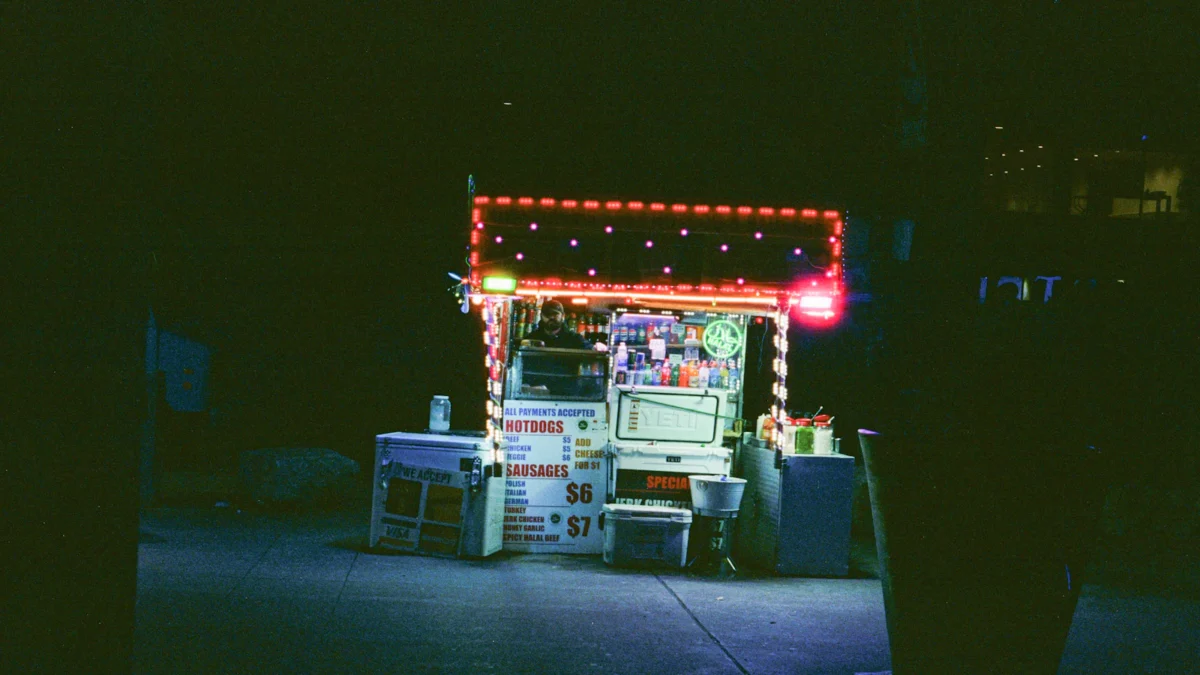
A food truck is a mobile kitchen, but in Singapore it is not a roaming street vendor. It operates at approved locations on an agreed schedule, and it goes back to a fixed backup kitchen every day. That structure shapes the whole business.
- Licensing. SFA’s list of businesses that need a licence places Mobile Food Wagons, meaning vehicles with full-fledged food preparation kitchens, under Food Shops.
- Locations. Each place you trade needs the landowner’s approval. Typical options are event grounds, private venues such as offices, campuses, malls and condominiums, and designated state land such as URA’s Marina Bay lots.
- Backup kitchen. SFA requires you to use an SFA-licensed establishment every day for wastewater disposal and water top-ups. Many operators also prepare ingredients there.
- Takeaway format. Some venues do not allow seating. URA’s Marina Bay conditions, for example, do not permit tables, chairs, umbrellas or tents, so customers take their food away.
Before you commit, compare a food truck with other small-format options. A hawker stall or a cloud kitchen may suit a similar menu with fewer moving parts. A truck makes most sense when your revenue comes from events, catering and rotating private venues.
Licences you need
SFA’s requirements page sets out the additional pre-licensing requirements for Mobile Food Wagons:
| # | SFA pre-licensing requirement |
|---|---|
| 1 | LTA registration or inspection pass documents for the motor vehicle to be used as a Mobile Food Wagon |
| 2 | Approval letters from the landowners for the wagon to operate at each designated location |
| 3 | A schedule of operations, including the day, time, location and approving agencies |
| 4 | An SCDF approval letter for the use and transport of LPG cylinders in vehicles, where applicable |
| 5 | The landlord’s approval for on-site cooking, where necessary |
| 6 | An approval letter from the owner of the backup kitchen |
| 7 | A wastewater tank at least 1.5 times the capacity of the freshwater tank, detachable so wastewater can be emptied into the sewer at the backup kitchen |
The licence itself is a Food Shop Licence. SFA’s fees page lists it at $195 for one year, and you apply on GoBusiness. Because the requirements depend on your vehicle, cooking method and locations, speak to SFA early and confirm what it needs for your specific setup.
Other approvals
- Food handlers. SFA’s food handler requirements say anyone who prepares or handles food must hold a valid WSQ Food Safety Course Level 1 certificate and be registered with SFA by the licensee.
- SCDF. Besides LPG approval, URA’s Marina Bay page requires a Temporary Change of Use permit from SCDF before the start date at that site, applied for on GoBusiness with at least one week’s processing time.
- Alcohol. Selling alcohol needs an SPF liquor licence. For one-off events, SPF lists a Class 5 temporary licence. Our bar guide sets out the classes.
- Everything else. URA notes that operators remain responsible for any other licences their operation needs, naming SCDF, SPF and NEA as examples. Use GoBusiness to check what applies to your concept.
Vehicle and equipment
The vehicle is both your kitchen and your shopfront, and it has to satisfy LTA as well as SFA. LTA’s vehicle modification page says some modifications need no approval, some need LTA approval and some are prohibited. It warns that unauthorised modifications can lead to fines of up to $20,000, imprisonment of up to two years, or both. LTA also says you must tell your motor insurer about modifications. Before you convert a vehicle:
- Ask LTA, or an LTA-Authorised Inspection Centre, whether the conversion you plan needs approval and inspection, and get it in writing.
- Use a fabricator who has built food trucks for the Singapore market and can show you the approvals from past builds.
- Confirm with SCDF how LPG cylinders must be stored and transported if you cook with gas.
Kitchen equipment on board
- Water tanks. A freshwater tank and a detachable wastewater tank at least 1.5 times its size, as SFA requires.
- Power. URA’s Marina Bay FAQ says food trucks should be self-sufficient in power as far as possible and that external generators will not be supported there, though operators can apply to connect to a smart pole. Plan your power budget around your cooking equipment.
- Cold storage. Under-counter chillers and freezers to keep ingredients at safe temperatures through the service.
- Cooking line. Keep the menu short so the line fits the truck. Every extra piece of equipment costs space, weight and power.
- Handwashing and cleaning. A sink supplied from the freshwater tank.
- Service hatch and POS. A counter with space for a tablet or terminal, a card reader and a printed or displayed QR code.
Where you can operate
SFA requires an approval letter from the landowner for every location and a schedule of operations. In practice, your locations come from three sources.
Marina Bay (URA)
URA’s food truck venue page lists five designated lots along the Marina Bay waterfront: Lots 1 and 2 at The Promontory, Lots 3 and 4 at Event Square next to Bayfront Link, and Lot 5 near the Red Dot Design Museum. Operators apply for a Non-Renewable Temporary Occupation Licence (NRTOL). URA lists these fees, inclusive of GST:
| Item | Lots 1, 2 and 5 | Lots 3 and 4 |
|---|---|---|
| How lots are allocated | First come, first served; daily up to 3 months | Balloted in fixed 3-month blocks |
| Daily NRTOL | $141.70 a day | Not applicable |
| Monthly NRTOL (max 3 months) | $1,144.50 a month | $1,635.00 a month |
| Processing fee (non-refundable) | $200 per application | $200 per application |
| Refundable security deposit | $3,000 per food truck | $3,000 per food truck |
| Electricity (optional, subject to approval) | $74.60 application charge per NRTOL, plus $25.10 per day per electrical point | $74.60 application charge per NRTOL, plus $25.10 per day per electrical point |
URA requires a valid SFA Mobile Food Wagon licence and LTA approval for the vehicle before you apply, says normal processing takes three to four weeks, and requires full payment before the start date. It does not allow tables, chairs, umbrellas or tents, so food is sold as takeaway.
Other locations
URA’s FAQ says it handles food truck applications only for Marina Bay, and that for other locations operators should contact the landowners directly. That means:
- Events and festivals. Organisers often recruit food trucks. Ask what approvals the organiser holds and what you must supply.
- Private venues. Offices, business parks, schools, condominiums and malls can host a truck with the owner’s written approval, and the landlord’s approval for on-site cooking where needed.
- Private functions. Weddings, corporate events and parties at private venues, again with the owner’s approval.
Temporary fairs
SFA’s temporary fair rules say the fair operator needs a Temporary Fair Permit, which its fees page lists at $60 per fair, and each stall preparing food needs a Temporary Fair Food Stall Licence, arranged through the fair operator at no separate fee. SFA also lists foods that cannot be sold at temporary fairs, such as sushi, sashimi, raw oysters and salads mixed on site. If you are invited to a fair, ask the organiser whether your truck is covered by your Mobile Food Wagon licence or needs a stall licence, and check with SFA if unsure.
Water, waste and food safety on the move
A truck has limited water, limited space and changing weather, so food safety needs more planning than in a shop.
- Daily water routine. SFA requires daily wastewater disposal and freshwater top-up at your SFA-licensed backup kitchen. Build it into the schedule so the truck never leaves with a full waste tank or an empty water tank.
- Never discharge on site. Wastewater goes into the sewer at the backup kitchen, which is why SFA requires a detachable wastewater tank.
- Prep at base. Do the heavy preparation at the backup kitchen and finish dishes in the truck. It keeps the truck cleaner and service faster.
- Temperature control. Keep chilled food cold between base and site, and check fridge temperatures during long services.
- Licensed sources. SFA says licensed food businesses may only sell food prepared on their licensed premises or bought from other licensed food businesses.
- Rubbish. Bring bins and take your refuse away unless the venue provides disposal. Leave every site as you found it; at Marina Bay, URA can deduct reinstatement costs from your deposit.
Taking payments on the go
Queues at a food truck move only as fast as payment. Plan for a portable setup that works without a fixed counter or cabling.
- PayNow and SGQR. A single SGQR code, as described by MAS, lets customers pay with many e-wallets and banking apps. Display it at the hatch.
- Cards and NETS. Many customers tap a card or phone. A portable terminal that links to your POS avoids keying amounts twice.
- Connection. Mobile data can drop at crowded events. ChaChaCha keeps taking orders if the internet drops and syncs later.
- Pre-orders. ChaChaCha’s QR pre-order flow (order, pay, collect) and online ordering page let customers order ahead and collect, which shortens the queue. ChaChaCha’s queue system sends SMS notifications, so customers do not have to crowd the hatch.
- Reconciliation. ChaChaCha supports PayNow, PayLah!, NETS, Visa/Mastercard and GrabPay, with automated reconciliation, so you can match each location’s takings at the end of the day.
- Sales by location. Use reports to compare sales by site and by hour, so you know which venues earn their fees.
See POS payments for payment methods, and our hawker POS page for a compact counter setup that suits a hatch. ChaChaCha pricing is quote-based; contact us for a quote.
Costs
Food truck costs depend heavily on the vehicle and conversion, so get written quotes. The only figures here come from official pages.
- Vehicle and conversion. Buying or leasing the vehicle, the kitchen fit-out, and any LTA inspection and approval costs. This is usually the largest item.
- Backup kitchen. Rent or a usage arrangement with an SFA-licensed establishment, which SFA requires.
- Licences. SFA Food Shop Licence at $195 a year, plus SCDF, and SPF permits if you sell alcohol.
- Location fees. At Marina Bay, URA lists $141.70 a day or $1,144.50 to $1,635.00 a month, plus a $200 processing fee and a $3,000 refundable deposit. Event organisers and private venues set their own terms, often a fixed fee or a share of sales.
- Running costs. Fuel, LPG, insurance, vehicle maintenance, parking at base, ingredients and staff.
- Technology. POS, portable card terminal and mobile data. Our POS cost guide explains the pricing models.
Model your revenue per location, not per month. A truck with a busy weekend event and quiet weekdays needs a different plan from one parked at a business park every lunchtime.
Grants
Enterprise Singapore’s EDGE Grant page says PSG, EDG and MRA combine into the EDGE Grant from 30 September 2026, with support of up to 70% for SMEs and levels that differ by activity. Grants are paid on reimbursement after the project, so you still need the cash first, and eligibility rules apply. AppsPOS, which powers ChaChaCha, has been a PSG pre-approved vendor and is approved under the EDGE Grant. See our grant guide for POS systems for how it applies to a POS package.
Checklist
- Decide the menu, target locations and whether a truck suits the concept better than a stall or cloud kitchen.
- Register the business with ACRA.
- Secure an SFA-licensed backup kitchen and an approval letter from its owner.
- Confirm with LTA whether your vehicle conversion needs approval and inspection; tell your insurer.
- Get SCDF approval for LPG use and transport if you cook with gas.
- Build the truck with a freshwater tank and a detachable wastewater tank at least 1.5 times larger.
- Collect landowner approval letters for each location and write your schedule of operations.
- Apply for the SFA Food Shop Licence (Mobile Food Wagon) on GoBusiness.
- Train and register food handlers with SFA.
- Apply to URA for Marina Bay lots, or sign agreements with event organisers and private venues.
- Set up a portable POS with PayNow/SGQR, cards and pre-orders; test it on mobile data.
- Run a trial service, then review sales by location every week.