Key takeaways
- You need an SPF liquor licence before you sell any alcohol. SPF lists Class 1A (all liquor, 0600 to 2359hrs) at $880 a year and Class 1B (all liquor, 0600 to 2200hrs) at $660 a year.
- SPF says it takes about three weeks to process a complete liquor licence application, which you submit on GoBusiness.
- Geylang and Little India are Liquor Control Zones. SPF lists shorter trading hours there, ending at 10.30pm on weekdays and 7pm on weekends, public holidays and their eves.
- Playing recorded music, hosting live bands or DJs, or allowing dancing usually needs a separate SPF Public Entertainment Licence.
- If you serve food, you also need an SFA Food Shop Licence, which SFA lists at $195 a year.
- Spirits and beer are high-value stock. Plan pour tracking, tabs and payments before you open.
This guide is general information, not legal advice. Fees and conditions were taken from official pages in September 2026 and can change, so check each agency’s latest page and GoBusiness before you commit money.
Choosing a bar concept and location
Pick your concept and your location together. The trading hours, entertainment and food you plan decide which licences you need, and some locations restrict all three.
- Concept. A cocktail bar, a craft beer taproom, a wine bar, a sports bar and a live music venue each need different licences, fit-out and staff. A beer-only taproom may suit a cheaper beer-only licence class. A late-night venue with DJs needs an entertainment licence and careful soundproofing.
- Trading hours. Work out when you expect to make money. An after-work bar that closes at 10pm needs a different licence from one that trades until midnight.
- Food. Bar snacks, a full kitchen or no food at all. Serving food brings SFA licensing, food handler training and kitchen works.
- Neighbours. Bars near homes attract noise complaints. A unit in a mall, hotel or commercial strip may be easier to run late than a shophouse with flats above it.
Location checks before you sign a lease
SPF’s liquor licence page says applicants must meet its “fit and proper” criteria and that the premises must be in a location suitable for supplying liquor. The application also needs approval from the land authority, such as HDB or URA/SLA. SPF’s licence conditions add that a licence can be suspended or cancelled if the land authority withdraws its support. Before you sign:
- Confirm the unit’s approved use allows a bar or restaurant, and get the landlord to state in writing that you can sell alcohol and, if you plan it, host entertainment.
- Check whether the unit sits inside a Liquor Control Zone (see below).
- Ask about exhaust, grease traps and gas if you plan a kitchen. Our restaurant guide covers these works in detail.
- Ask the landlord about noise limits, operating hours in the building and any past complaints.
Liquor licences
Singapore liquor licensing is run by the Singapore Police Force under the Liquor Control (Supply and Consumption) Act. SPF’s licence classes page lists the following, each valid for one year unless stated:
| Class | What it covers | Trading hours | Fee |
|---|---|---|---|
| 1A | All liquor, including beer, consumed on the licensed premises | 0600 to 2359hrs | $880 a year |
| 1B | All liquor, including beer, consumed on the licensed premises | 0600 to 2200hrs | $660 a year |
| 2A | Beer only, consumed on the licensed premises | 0600 to 2359hrs | $460 a year |
| 2B | Beer only, consumed on the licensed premises | As indicated on licence | $285 a year |
| 3A | Retail supply of liquor for consumption elsewhere, typically deliveries or takeaway | 0700 to 2230hrs | $110 a year |
| 3B | Retail supply of beer only for consumption elsewhere | 0700 to 2230hrs | $110 a year |
| 4 | Wholesale supply of liquor for consumption elsewhere | 0700 to 2230hrs | $110 a year |
| 5 | Temporary licence for short events such as once-off events and exhibitions, up to 30 consecutive days | Specified period | From $22 (1 day) to $220 (30 days) |
Most bars serving spirits, wine and cocktails will look at Class 1A or 1B. A beer-only taproom may fit Class 2A or 2B. If you also want to sell bottles or cans for takeaway or delivery, check whether you need a Class 3 licence as well. The fees are non-refundable, so choose the class carefully.
Who can apply and how
According to SPF’s application page, companies, businesses and societies can apply, using Singpass or Corppass on GoBusiness. The documents listed include your ACRA or ROS certificate, the NRIC or FIN of a contact person, and approval from the land authority. SPF says processing takes about three weeks from receipt of a complete application, and you can renew within two months before expiry. Apply early enough that the licence is in hand before your soft opening.
Conditions to know
SPF’s restrictions and conditions, dated 1 May 2026, say the licensee must report offences such as affray, disorderly behaviour, rioting and causing hurt on the premises to the police, must not remove evidence, and must not let the premises promote those offences through posters or decorations. You also need SPF’s approval before changing the business name. If you have an outdoor refreshment area, the conditions say you can serve liquor there only during your licence’s trading hours.
Liquor Control Zones and trading hours
The Act also restricts drinking in public. The Ministry of Home Affairs’ announcement of the Act says drinking in all public places is prohibited from 10.30pm to 7am every day, and that retail shops cannot sell takeaway liquor during those hours. That matters for a bar even if all your guests drink inside: if customers spill out onto a public walkway with drinks late at night, they may be breaking the law.
Geylang and Little India
MHA designated Geylang and Little India as Liquor Control Zones. MHA says public drinking there is also banned from 7am on Saturday to 7am on Monday, and from 7pm on the eve of a public holiday to 7am on the day after, and that offences in these zones carry penalties one and a half times those elsewhere.
For licensed premises, SPF’s liquor licence page lists these trading hours in both zones:
| Liquor Control Zone | Weekdays (Mon to Fri) | Weekends, public holidays and eves |
|---|---|---|
| Geylang | 7am to 10.30pm | 7am to 7pm |
| Little India | 7am to 10.30pm | 7am to 7pm |
SPF publishes boundary maps for both zones. If a unit is near either area, check the map before you sign. A bar that depends on weekend nights is a difficult fit inside a zone that stops trading at 7pm on Saturdays.
Entertainment licence (if applicable)
Music and performance are licensed separately from alcohol. SPF’s Public Entertainment Licence overview says a licence is required for public entertainment in a place the public can access, unless the activity is specifically exempted. SPF’s licence types and fees name bars, pubs, lounges, cafés and restaurants among the nightspots that commonly need one, in two categories:
- Category 1: recorded music, live music, singing, variety acts or dancing, including dancing by customers.
- Category 2: recorded music, where customers do not dance.
| Category | Type A (to 1am Mon to Sat, 2am Sun and PH) | Type B (to 3am Mon to Sat, 4am Sun and PH) | Type C (to 6am daily) |
|---|---|---|---|
| 1: live performance or dancing | $720 a year | $960 a year | $1,200 a year |
| 2: recorded music, no dancing | $260 a year | $350 a year | $440 a year |
SPF also lists ad hoc licences at $22 for one day or $44 for seven days, which can suit a one-off event. Its overview adds that sunk investments are not grounds for granting a licence, so do not build a stage or dance floor before you know the premises can be licensed. Apply through GoBusiness.
Noise
SPF’s published licensing conditions for bars and lounges without live entertainment (dated 2017) include soundproofing requirements unless exempted: sound at the premises boundary must not exceed 65dBA Leq (1h), amplified music must not exceed 55dBA Leq (1h) at the nearest home after 10.30pm, and windows and doors must stay closed during operation except for people entering and leaving. Check the conditions attached to your own licence, and ask an acoustic consultant to review the fit-out if you are near homes.
Fit-out and bar equipment
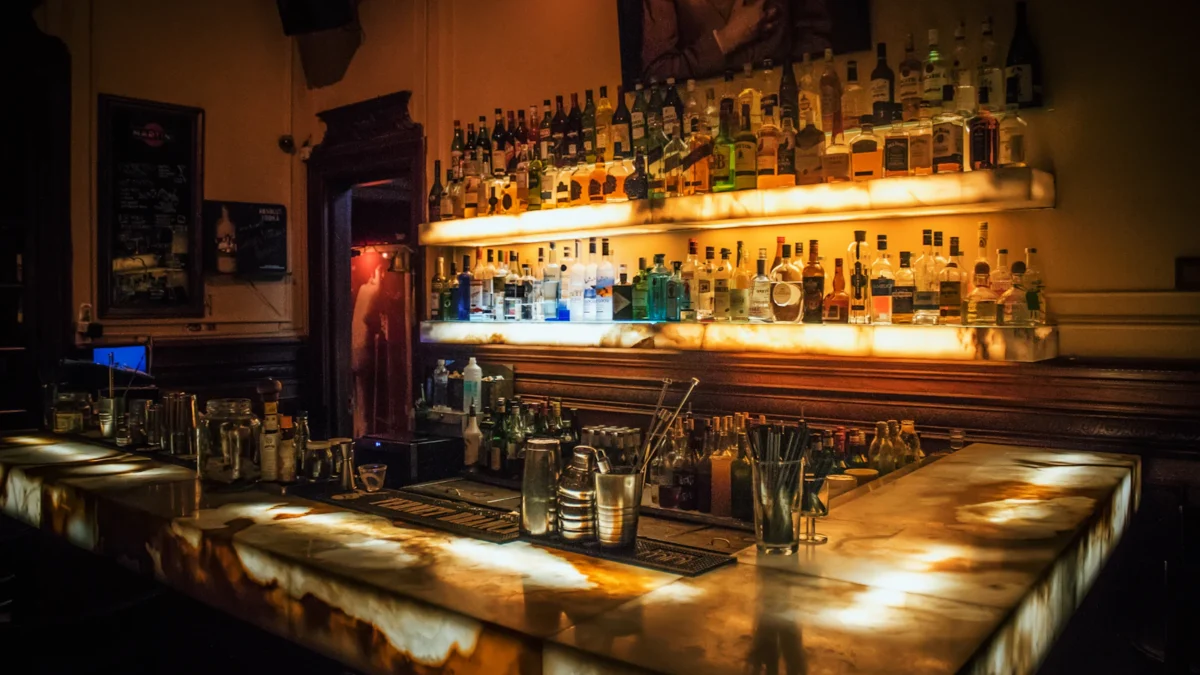
A bar fit-out is built around the back bar and the speed of service. Plan these items with your designer and contractor:
- Bar layout. Stations with ice wells, speed rails, sinks and a clear path between the pour point and the till. Each bartender should reach the most-used bottles without walking.
- Refrigeration. Under-counter bottle chillers, glass chillers if you use them, and a cold room or keg cooler sized for your beer range.
- Draught system. Kegs, lines, couplers and a cleaning routine. Ask your beer supplier what they install and maintain.
- Ice machine and glasswasher. A bar runs out of ice and clean glasses before it runs out of drinks. Size both for your peak hour.
- Secure storage. A lockable liquor store with limited access. Spirits are the easiest stock to lose.
- Sound and lighting. Speaker placement, acoustic treatment and a sound limiter if your entertainment licence requires noise control.
- Kitchen. If you serve food, the kitchen layout goes into your SFA application. SFA lists the Food Shop Licence at $195 a year on its fees page. Our café guide explains the layout plan and inspection steps.
- POS, printers and payment terminals. Decide where terminals, bar printers and card readers go before the counter is built, so power and data points are in the right place.
Staffing and responsible service
A bar team is usually smaller than a restaurant’s, but every shift needs someone who can refuse service and handle trouble. Typical roles are a bar manager, bartenders, servers or bar-backs, a door host on busy nights, and cooks if you run a kitchen.
- Food hygiene. SFA’s food handler requirements name bartenders among the people who must hold a valid WSQ Food Safety Course Level 1 certificate and be registered with SFA by the licensee.
- Refusing service. Train staff to check ID and to refuse service to anyone underage or drunk. SPF’s licence conditions state that automated vending systems must not supply liquor to anyone drunk or under 18, and SPF’s application page says licensees must not supply liquor to anyone under 18 through online or telecommunication services. Apply the same standard at the bar counter.
- Disorder. The licence conditions say you must not permit disorderly behaviour on the premises and must report offences to the police. Write a simple incident procedure and make sure every shift lead knows it.
- Cash and voids. Decide who can void a drink, comp a round or reopen a closed tab. Staff permissions in the POS let you enforce that.
Build the roster around your peak nights, not a flat headcount. Our F&B staff roster guide covers the details.
Stock control for spirits and beer
In a bar, the gap between what you bought and what you sold is where the margin goes. Over-pouring, free drinks for friends, breakage and theft all look the same on the monthly accounts unless you count properly.
- Standard pours. Set a measure for every spirit and cocktail, and use jiggers or pourers. Write the recipe into the POS so each cocktail sale deducts the right amount of each ingredient.
- Regular counts. Count high-value spirits often, at least weekly, and compare usage against sales. Beer can be counted by keg and case.
- Variance reports. Compare expected usage with the count. A large gap on one bottle or one shift is the signal to look closer.
- Receiving. Check deliveries against the invoice before signing, especially for spirits.
- Wastage log. Record breakages, spills and staff drinks so they do not show up as unexplained losses.
ChaChaCha’s inventory management and reports help you track stock against sales, and the bar POS page shows how it fits a bar. Staff permissions limit who can void or discount, which closes one of the common gaps.
Tabs, happy hour and payments
Bar service has patterns that a retail till does not handle well. Check these before you choose a POS:
- Tabs. Guests open a tab, order through the night and pay at the end. ChaChaCha’s POS supports tabs and split bills, so a group can pay separately without the bartender recalculating by hand.
- Happy hour. Set prices that change by time of day and apply automatically, so bartenders do not key in manual discounts. Ask each vendor, including us, to show you how time-based pricing is set up before you sign.
- Modifiers. Spirit choice, mixer, double shot, no ice. ChaChaCha supports custom modifiers so the ticket shows exactly what to pour.
- Table and counter service. Table management shows which tables are open and what they have ordered. QR ordering lets guests reorder a round from the table.
- Offline operation. A busy Friday cannot stop because the internet drops. ChaChaCha keeps taking orders offline and syncs later.
- Payments. ChaChaCha supports PayNow, PayLah!, NETS, Visa/Mastercard and GrabPay, with split payments and automated reconciliation. See POS payments.
The Carpenters Bar is among AppsPOS’s clients. ChaChaCha pricing is quote-based, so use the POS cost calculator for a rough estimate or ask us for a quote.
Costs and grants
Bar budgets vary too much for a meaningful typical figure, so list every category and get written quotes. The licence fees below come from official pages; everything else depends on your site and concept.
| Cost category | What to budget for |
|---|---|
| Liquor licence | $880 a year for Class 1A or $660 for Class 1B (SPF) |
| Public Entertainment Licence | $260 to $1,200 a year depending on category and hours (SPF), if you need one |
| SFA Food Shop Licence | $195 a year (SFA), if you serve food |
| Fit-out | Bar counter, refrigeration, draught system, ice machine, soundproofing, lighting |
| Opening stock | Spirits, wine, beer, mixers and garnishes; often a large upfront cash outlay |
| Technology | POS terminals, printers, payment terminals, QR ordering. See our POS cost guide |
| Working capital | Rent, wages and supplier payments for the months before trade builds up |
Enterprise Singapore’s EDGE Grant page says PSG, EDG and MRA combine into the EDGE Grant from 30 September 2026, with support of up to 70% for SMEs and levels that differ by activity. Grants are paid on reimbursement, so you still need the cash upfront, and eligibility rules apply. AppsPOS, which powers ChaChaCha, has been a PSG pre-approved vendor and is approved under the EDGE Grant. See our grant guide for POS systems.
Checklist
- Decide the concept, trading hours, food offer and entertainment.
- Register the business with ACRA.
- Shortlist units; check approved use, Liquor Control Zone boundaries, neighbours and landlord rules on alcohol and music.
- Get written landlord or land authority support for liquor supply.
- Choose your liquor licence class and apply on GoBusiness, allowing about three weeks for processing.
- Apply for a Public Entertainment Licence if you play music, host performers or allow dancing.
- Apply for an SFA Food Shop Licence if you serve food, with an approved layout before renovation.
- Design the bar with power and data points for POS, printers and card terminals.
- Soundproof to the standard your licence conditions require.
- Hire and train staff; register food handlers with SFA; write your refusal and incident procedures.
- Set up the POS menu, modifiers, recipes, happy hour pricing and staff permissions.
- Take your first stock count and set a weekly counting routine.
- Run a soft opening and test tabs, split bills and payments.
- Review variance, sales by hour and staff performance weekly after opening.