Key takeaways
- SFA lists caterers under Food Shops, so a catering kitchen that sells to consumers and companies needs a Food Shop Licence. SFA states it costs $195 and is valid for one year.
- Catering cannot be run from home. SFA says home-based food businesses must not offer catering, including buffet lines or packed meals, and licensed caterers are not allowed to run catering services from home.
- SFA’s guidance for catered meals says no food should be kept at room temperature for more than 4 hours from cooking to eating, and every buffet table or packed meal must carry a time stamp. That rule shapes your whole event schedule.
- If you want halal clients, MUIS certifies caterers under the Food Preparation Area scheme, which has its own staffing and transport conditions.
- Deposits, final headcounts and clean invoices for corporate clients protect your cash flow as much as your menu does.
This guide is general information, not legal advice. Rules were taken from Singapore Food Agency (SFA) and MUIS pages in September 2026. Check the latest with SFA and MUIS before you commit to premises or menus. The general steps for any food business (ACRA registration, checking a unit’s approved use, SFA layout plans, SCDF and hiring) are covered in our restaurant guide.
Pick your catering model
“Catering” covers several different businesses. Decide which one you are building, because it drives your kitchen size, vehicles, staffing and paperwork:
- Packed meals (bento and packet meals). Individually packed meals for offices, schools, seminars and site workers. High volume, tight delivery windows, low set-up work at the venue.
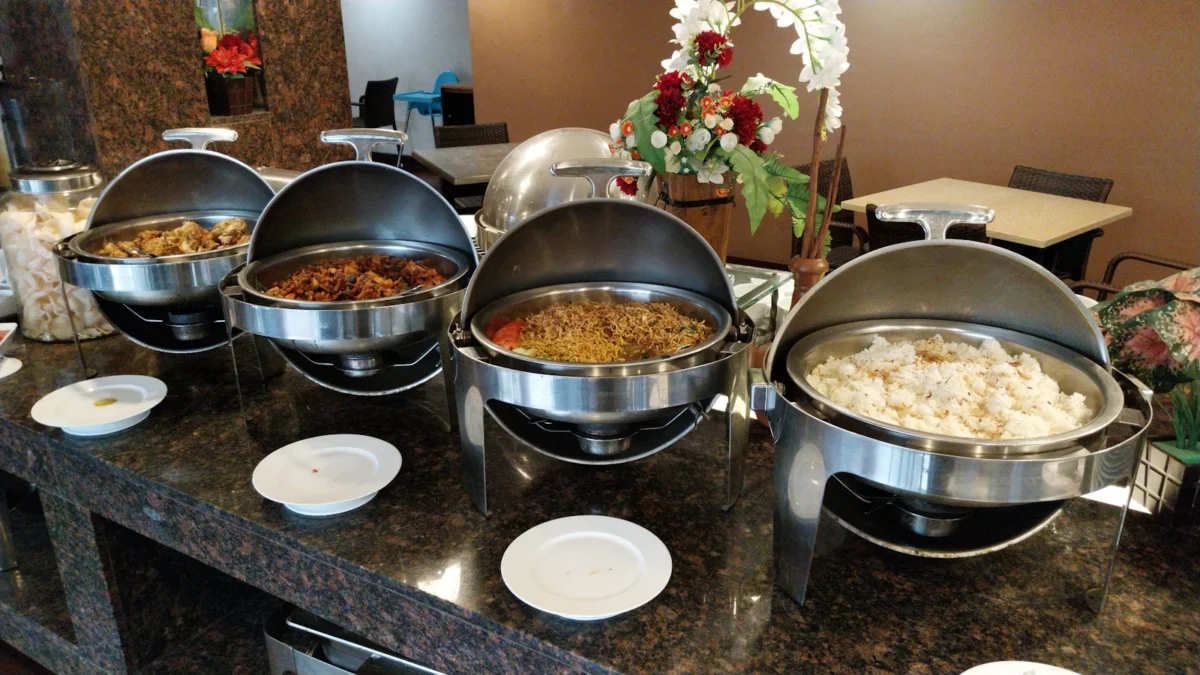
- Buffet catering. Chafing dishes, a buffet line and sometimes staff on site for weddings, birthdays, corporate events and void-deck gatherings. More equipment and more time management.
- Mini-buffets and platters. Smaller drop-off sets for home parties and office meetings, often ordered online.
- Corporate and contract catering. Recurring orders for companies, with invoices, credit terms and sometimes supplier registration on the client’s side.
- Catering alongside a restaurant. Many restaurants add catering from their existing kitchen to use quiet hours. Check with SFA that your licence and layout cover the extra volume.
Most caterers start with one model and add others. A caterer that begins with office bentos may later add weekend buffets, which means buying chafing dishes, hot boxes and a larger vehicle.
Which SFA licence does a caterer need?
Catering to consumers and companies: Food Shop Licence
SFA’s page on businesses that need a food retail licence says “Food Shops include: restaurants, caterers, coffeeshops, canteens” and similar premises. A catering kitchen that prepares food for events, households and companies therefore applies for the Food Shop Licence on GoBusiness. SFA’s application process and fees page states: “The Food Shop Licence costs $195 and is valid for 1 year.” You submit a layout plan, renovate to the approved layout and pass a pre-licensing inspection. Our bakery guide walks through the same steps.
Supplying other food businesses: a different licence
If your kitchen will supply your own outlets or other food businesses, rather than end customers, SFA may treat you as a food processing establishment. SFA’s page on food manufacturing and storage says businesses that supply “their other outlets or other food businesses” are considered a food processing establishment, “such as a central kitchen”. SFA’s fees page lists a $147.20 application fee and annual licence fees from $180 depending on floor area. Our cloud kitchen guide covers this split in more detail. If your model mixes events and supplying other businesses, describe it to SFA before you sign a lease.
Food handlers and inspections
Everyone who prepares food needs WSQ Food Safety Course Level 1 under SFA’s food handler requirements. Caterers are also Category 1 establishments under SFA’s SAFE grading framework, grouped with central kitchens and larger restaurants. Our SFA inspection guide explains the grades and the demerit points system.
Why you can’t cater from home
Home-based cooks often ask whether they can take small catering orders from their flat. SFA’s answer is clear. Its requirements for home-based food businesses say home-based food businesses “are not allowed to offer food catering services given its scale of operations”. SFA explains that catering “includes the provision of buffet lines or packed meals” and that “only SFA-licensed food businesses can offer food catering”. It adds that licensed caterers “are not allowed to run catering services from home”.
Home-based food businesses can still sell food to consumers without an SFA licence, but they must follow food safety laws and cannot sell to licensed food retailers. URA’s Home-Based Business Scheme also bans non-resident employees, signage and heavy equipment not meant for domestic use. HDB residents should check HDB’s own scheme conditions. So a home cook who wants to move into buffets or packed meals needs licensed premises first. Our bakery guide sets out the home-based rules in full.
SFA’s own guidance for people ordering catered meals tells them to “engage only licensed food caterers”, and it points them to SFA’s list of licensed establishments. Expect corporate clients and event planners to check that you are licensed.
Kitchen, vehicles and equipment
A catering kitchen is built around volume and holding, not à la carte speed. When you look at premises and plan the layout, think about:
- Batch cooking. Large kettles, tilting pans, combi ovens and rice cookers sized for hundreds of portions.
- Cooling. SFA’s page on temperature control in cooked food warns that large quantities of food take longer to cool, and suggests dividing food into smaller portions and using shallow pans. Blast chillers help if you cook ahead.
- Packing area. A clean, separate area for portioning and packing meals, away from raw food.
- Hot and cold holding. Hot boxes, insulated bags and cooler boxes for transport, and food warmers at the venue.
- Buffet kit. Chafing dishes with covers, serving utensils, table linen and display risers. Count what you need for your largest likely event, plus spares.
- Vehicles. Your own van or a delivery partner. Loading access at the kitchen matters when you are moving dozens of trays before lunch.
- Washing. Returned chafing dishes and trays come back dirty. Plan space for washing and drying them the same day.
We don’t quote equipment prices here. Get written quotes from two or three suppliers, and ask about servicing.
Food safety in transit and on the buffet table
This is where catering differs most from a restaurant. SFA’s Guidelines for Ordering Catered Meals for Functions and Events (updated 31 May 2019) are written for customers, but they spell out what SFA expects from caterers:
- The danger zone. SFA says food pathogens “multiply rapidly between 5°C and 60°C”. Keep hot food above 60°C and cold food below 5°C.
- The 4-hour rule. “No food should be kept at room temperature for more than 4 hours from the time it was cooked at the caterer’s kitchen to the time it is consumed.” Packing, transport and set-up all count towards the 4 hours.
- Time stamps are mandatory. SFA says a time stamp label on each packed meal, or a time stamp sign on each buffet table, has been “a mandatory requirement with effect from 15 February 2012”. The “CONSUME BY” time should not be later than 4 hours from when the food is cooked or ready to eat and kept between 5°C and 60°C. It is an offence to remove or alter the sign.
- Delivery timing. SFA advises customers to request delivery “at most 1 hour before meal time and not earlier than that”.
- Chafing dishes are not a fix. SFA notes that canned fuels under chafing dishes cannot keep food hot above 60°C and “cannot extend the shelf-life of the food”. For long events, it suggests putting out small portions and keeping the rest in hot boxes, or delivering a second fresh batch.
- Raw food. Raw seafood such as sashimi should be delivered chilled below 5°C and kept chilled until served.
In a written answer to Parliament in July 2023, MOM also stated that “all catered food, including pre-packed meals, from licensed caterers are required to be delivered in insulated boxes and time-stamped”. SFA’s licensing conditions are the final word, so check the latest with SFA.
For self-service buffets, SFA’s food shop requirements say that since 2022, operators offering self-service buffets must provide an adequate number of hand sanitisers or disposable gloves in the food display area. If your staff run the buffet at a client’s venue, bring these as standard kit. For deliveries, SFA’s food delivery page points to Singapore Standard SS 672:2021 on delivering ready-to-eat food, which our cloud kitchen guide summarises.
Keeping food in the danger zone for more than 4 hours is also one of SFA’s listed offences with demerit points. See our SFA inspection guide.
Halal catering
Many corporate, community and wedding events in Singapore need halal food, so halal certification can open a large part of the market. MUIS’s scheme types page says the Food Preparation Area (FPA) scheme is “issued to catering establishments and central kitchen facilities”. MUIS’s FPA Halal Certification Conditions (version 4.1, effective 9 March 2026) include catering-specific conditions, among them:
- Engaging at least 3 permanent Muslim personnel, one of whom is appointed Halal Assurance Officer with a supervisory role.
- Keeping a log of every order and delivery, including the event name and date, menu, number of people, staff who delivered and set up the food, the client’s contact details, a copy of the time stamp signage and the vehicle used.
- Declaring all vehicles and transporting food in halal-dedicated vehicles.
- Not preparing or cooking the food further outside the halal-certified kitchen.
- At events with both halal and non-halal food, no cross-mixing, with MUIS’s QR code displayed in a way that does not mislead.
MUIS’s fee schedule lists FPA certification at $1,000 a year for premises up to 186 m² and $1,220 above that, plus an application fee, before GST. The full process, timelines and staff requirements are in our MUIS halal certification guide, and our festive season playbook covers Hari Raya demand. This is a summary of MUIS’s published conditions, not religious advice, so check with MUIS.
Pricing, deposits and cancellations
Catering cash flow is lumpy. You buy ingredients and pay staff days before the event, and a cancelled wedding buffet can wipe out a week’s margin. Set your terms before the first booking:
- Price per head or per set, with minimums. State the minimum order, delivery charges by zone and any surcharge for early mornings, public holidays or venues without lift access.
- Deposit on confirmation. Take a deposit to hold the date, and the balance before or on the event day. Write down what happens to the deposit if the client cancels, and by when.
- Final headcount deadline. Fix a date after which the headcount can go up but not down. This protects your ingredient orders.
- Clear quotes. List menu items, quantities, set-up time, collection time for equipment and whether GST applies.
- Costing. Cost every set per head, including packaging, disposables, fuel and transport. Our guide to food cost in Singapore shows how.
If you are GST-registered, ask your accountant how deposits and cancellation charges are treated for GST, and check the latest on IRAS.
Invoicing corporate clients
Corporate clients usually want a quotation, a tax invoice with their company details and sometimes a purchase order number, and many pay on credit terms. Agree payment terms in writing before the event, and chase overdue invoices on a schedule rather than when you remember.
E-invoicing is changing too. IRAS is rolling out the GST InvoiceNow Requirement for GST-registered businesses in phases, and catering invoices to companies are business-to-business invoices whose data must be submitted. Our InvoiceNow guide explains the dates and what counts. Keep your POS, invoices and accounts in step. Our POS accounting integration page explains how sales flow into Xero.
Event logistics and a POS set-up for caterers
A good catering operation runs from a written schedule for each event, worked backwards from the meal time:
- Order confirmed: menu, headcount, venue address, access and lift details, contact person on the day, dietary and allergy notes.
- Day before: production list by dish and tray count, equipment checklist, driver and set-up crew assigned.
- Cook time: set so that delivery lands no more than an hour before the meal and the 4-hour window covers the whole event.
- Load-out: hot boxes and cooler boxes checked, time stamp signs printed, sanitisers or gloves packed for self-service buffets.
- On site: set up, brief the client on the “consume by” time, photograph the set-up.
- Collection: clear leftovers and equipment after the meal; SFA advises that leftovers should be discarded, not packed for later.
On the systems side, the jobs that matter most for a caterer are taking orders ahead, collecting payment and getting clean numbers into your books:
- Pre-orders. ChaChaCha’s pre-order flow (order, pay, collect) and online ordering page let customers order and pay upfront for platters and mini-buffets, with orders going to the kitchen. See QR ordering.
- Payments. ChaChaCha accepts PayNow, PayLah!, NETS, Visa/Mastercard and GrabPay, supports split payments and reconciles payments automatically. See POS payments.
- Kitchen. A KDS with station routing, prioritisation and prep timers, and Epson cloud printing to several printers, including a packing station.
- Delivery. Lalamove for delivering your own online orders.
- Accounts. Xero integration, so sales reach your accounting file without re-keying, plus reports by item and day.
Every caterer takes deposits and bills companies differently. For part-payment deposits, balance tracking and invoices on credit terms, ask us to confirm how your workflow would run, and get it in writing from each vendor, including us. ChaChaCha pricing is quote-based. The EDGE Grant guide explains grant support for POS systems.
Catering launch checklist
| Stage | Task |
|---|---|
| Model | Decide: packed meals, buffets, platters, corporate or a mix |
| Licence | Food Shop Licence for catering premises; ask SFA if supplying other businesses needs a food processing establishment licence |
| Premises | Licensed commercial kitchen (not home), with packing area, cooling, washing and loading access |
| People | WSQ Food Safety Course Level 1 for all food handlers; set-up crew trained on the 4-hour rule |
| Food safety | Hot boxes and cooler boxes, time stamp labels and signs, sanitisers or gloves for buffets |
| Halal | If needed, prepare for MUIS FPA scheme: Muslim staff, halal-dedicated vehicles, order logs |
| Terms | Minimum orders, deposit and cancellation policy, final headcount deadline, payment terms |
| Systems | Pre-orders, payments, KDS and printing, invoicing, Xero sync; check InvoiceNow dates |
| Launch | Test runs with timed delivery, then open to repeat corporate clients first |
Want to see how pre-orders, payments and Xero sync would look for your catering kitchen? Talk to us for a demo and a quote.