Key takeaways
- Reply to restaurant negative reviews promptly, politely and briefly. Future customers read your reply as much as the complaint.
- Acknowledge, apologise for the experience, explain what you are doing, and move the detail offline.
- Most complaints are best solved at the table, before they become reviews. Train staff to listen, apologise and act.
- Track complaints by type and match them against POS data such as ticket times and voids to find the real cause.
- Only report reviews that break Google’s policies, and never reveal a customer’s personal details in a public reply.
Why responses matter
Diners in Singapore check reviews before choosing where to eat, especially for a new place or a special occasion. A handful of complaints will not sink a good restaurant, but a string of unanswered ones, or a defensive reply, can make people choose the place next door.
Replying does three things. It shows the reviewer you listened, which sometimes brings them back. It shows everyone else reading that you take service seriously. And it forces your team to look at the problem rather than dismiss it. Google puts it simply in its Business Profile help: “Helpful and positive replies to reviews can show that you’re responsive to your customers” (Google Business Profile Help).
Reviews are only one part of your reputation. For the wider picture, including setting up your Google Business Profile and asking happy customers for reviews, see our guide to restaurant marketing in Singapore.
Responding to online reviews
Whether the review is on Google, a food directory or a social platform, the same principles apply.
Before you reply
- Check the facts. Find the visit in your POS by date, time and table if you can. Talk to the staff on shift.
- Wait until you are calm. Replying within a day or two is good. Replying in anger within five minutes is not.
- Decide who replies. Pick one or two people, usually the owner or outlet manager, so the voice stays consistent.
How to structure a reply
- Thank them for taking the time to write.
- Acknowledge the specific issue without arguing about details.
- Apologise for the experience, even if you disagree with parts of the account.
- Say what you have done or will do, briefly and concretely.
- Invite them to continue offline through a general contact channel, such as your outlet email or phone.
What to avoid
- Blaming the customer, the delivery rider or a “new staff member”.
- Copy-pasting the same reply to every review. Readers notice.
- Offering compensation publicly in a way that invites others to complain for freebies.
- Revealing booking details, order contents, phone numbers or anything else that identifies the reviewer.
On Google, you reply from your Business Profile by opening “Read reviews” and responding to the review. Google notes that replies are checked against its content policies before they appear, and that this is usually quick but can take longer, so do not worry if your reply does not show immediately (Google Business Profile Help).
Templates for common complaints
Use these as a starting point and personalise each one. Change the wording so every reply sounds like your restaurant.
Slow service
“Thank you for your feedback, and we’re sorry you waited so long for your food on Saturday evening. That is not the experience we want for anyone. We were short-handed in the kitchen that night and have since adjusted our weekend roster. We’d appreciate the chance to look after you properly next time. Please reach us at [outlet email] if you’d like to share more.”
Wrong order
“We’re sorry your order arrived incorrectly, and thank you for letting us know. We’ve reviewed how orders are passed to the kitchen and reminded the team to read back orders at the table. If you contact us at [outlet email], our manager would like to make this right.”
Price or portion
“Thank you for the honest feedback on value. We price our dishes based on the ingredients and preparation involved, but we take your point about portion size seriously and are reviewing it with our chef. We hope you’ll give us another try.”
Hygiene or food safety
“Thank you for raising this. We take hygiene very seriously and have looked into it with our kitchen team straight away. We’d like to understand exactly what happened, so please contact our manager directly at [outlet email].”
Hygiene complaints deserve extra care. Investigate immediately, keep records of what you checked, and avoid debating details in public. If a complaint suggests a wider food safety problem, deal with the cause first and the reply second.
Handling complaints in person
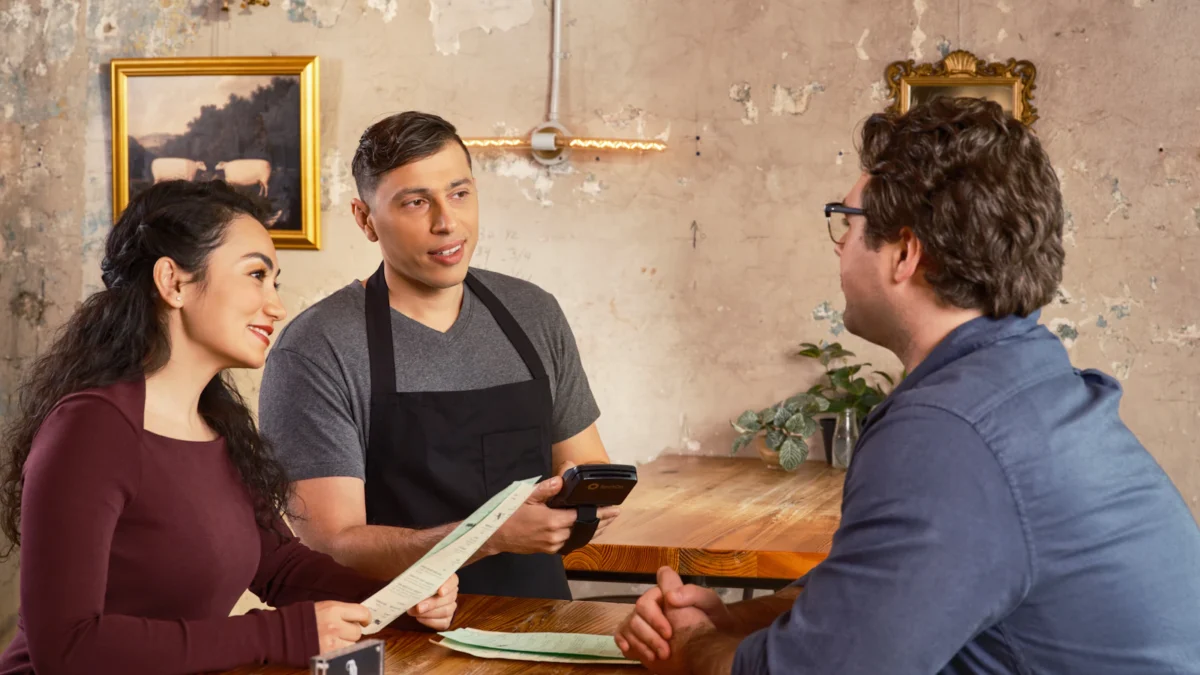
The best complaint is one that is solved before the customer leaves. Many negative reviews start as a small issue that nobody addressed at the table.
A simple framework for staff
- Listen fully. Let the customer finish without interrupting or explaining.
- Apologise sincerely. “I’m sorry, that shouldn’t have happened” goes a long way.
- Act quickly. Replace the dish, chase the order, adjust the bill as your policy allows.
- Escalate when needed. Staff should know when to call the manager, such as for allergy concerns, hygiene issues or repeated problems.
- Follow up. Check back before the customer leaves to confirm they are satisfied.
Give front-of-house staff clear limits on what they can do without a manager, for example replacing a dish or offering a free drink. With staff permissions in your POS, you can let supervisors apply certain discounts or voids while requiring a manager for larger ones, and every action is recorded with a reason.
Brief the team at pre-shift meetings on recent complaints and what changed as a result. Staff are more careful when they can see that feedback leads somewhere.
Turning feedback into fixes
A reply calms one customer. Fixing the cause helps every customer after them.
Track complaints in one place
Keep a simple log of every complaint, whether it came online, in person or by message. Record the date, time, outlet, channel, category (speed, accuracy, food quality, price, cleanliness, staff attitude) and what you did. Review it weekly. Patterns appear quickly: slow service complaints clustered on Friday nights, or wrong orders concentrated on one station.
Match complaints against POS data
- Ticket times. A kitchen display system with prep timers and order prioritisation shows how long each ticket took and which station fell behind. If complaints about slow food line up with long ticket times on the grill, you know where to look.
- Voids and remakes. A spike in voided or remade items for one dish often points to a recipe, training or equipment problem.
- Item returns and comps. Record returned dishes with a reason code. Over a month, the most-returned items tell you what to fix or drop.
- Peak-hour sales. Compare covers per hour with staffing on the roster. Complaints often follow under-staffed peaks.
Your POS reports can bring these figures together by outlet, day and hour. Change one thing at a time, then check whether complaints and the related numbers improve.
Fake or unfair reviews
Sometimes a review is not genuine: a competitor, a former employee, or someone who never visited. Google’s Maps content policy prohibits “Content that is not based on a real experience or does not accurately represent the location or product in question”, and content based on a conflict of interest, which “may include current or former employment” (Google Maps User Generated Content Policy). The policy also prohibits categories such as harassment, hate speech, impersonation and off-topic rants.
You can report a review from your Business Profile, or through Google’s reviews management tool. Google states that “only those that violate Google policies are eligible for removal”, that evaluation “typically takes several days”, and warns: “Do not report a review just because you disagree with it or dislike it” (Google Business Profile Help).
While a report is pending, it is usually still worth posting a short, calm reply, for example: “We can’t find any record of this visit. Please contact us at [outlet email] so we can look into it.” Never offer incentives for reviews or ask staff and friends to post reviews to balance things out, as that can itself breach the platform’s policies. Other directories and platforms have their own rules, so check each one’s policy before reporting.
Service recovery offers
When a complaint is valid, a thoughtful gesture can turn an unhappy guest into a loyal one. Keep offers proportionate and make them privately, not in a public review reply.
- At the table: replace the dish, remove it from the bill or offer a drink or dessert, within the limits you have set for staff.
- After the visit: invite the guest back with a voucher for a future visit, sent directly to them once they contact you.
- For members: if the guest is in your loyalty programme, you can add bonus points or issue a voucher to their account.
ChaChaCha’s CRM and loyalty tools support vouchers, points and stamps, stored value and birthday rewards, so a recovery voucher can be issued and tracked like any other reward. Give each recovery voucher a clear expiry and a distinct code so you can see how many guests came back. For more ways to use rewards, see our restaurant loyalty programme ideas.
PDPA care when replying
Singapore’s Personal Data Protection Act (PDPA) governs how organisations collect, use and disclose personal data. The safe rule for review replies is simple: do not disclose anything about the customer that they did not publish themselves.
- Do not mention booking names, phone numbers, email addresses, order history, membership status or how often they visit.
- Do not post CCTV stills, receipts or screenshots of their order.
- Do not use personal data collected for bookings or loyalty to contact a reviewer unless that use is consistent with the purpose you collected it for and what they agreed to.
- Move the conversation to a private channel and let the customer choose to share their details with you.
If you are unsure whether a particular reply or follow-up is allowed, check the Personal Data Protection Commission’s guidance or get professional advice before posting. When sending follow-up marketing messages, the Do Not Call rules also apply; our restaurant marketing guide covers the basics.
Negative review and complaint checklist
- One or two named people responsible for review replies
- Reviews checked at least every few days across Google and key directories
- Facts checked against POS records and staff before replying
- Reply structure: thank, acknowledge, apologise, act, move offline
- Templates personalised; no copy-paste replies
- No personal data, receipts or order details in public replies
- Staff trained on listen, apologise, act, escalate, follow up
- Clear staff limits for comps and discounts, set through POS permissions
- Complaint log kept and reviewed weekly by category
- Ticket times, voids and returns checked against complaint patterns
- Only policy-breaking reviews reported, with a calm public reply meanwhile
- Recovery vouchers issued privately, with expiry and distinct codes
Want to see how kitchen timers, reports and loyalty vouchers work together for service recovery? Contact us for a walkthrough.