Key takeaways
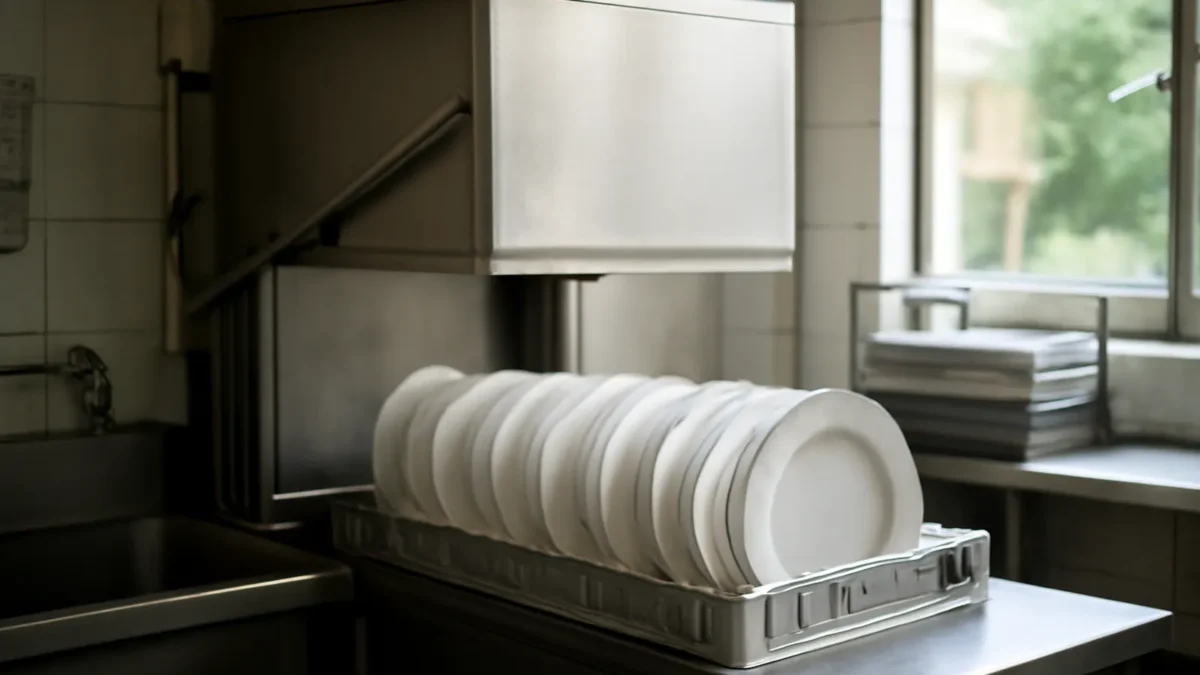
- There are three main types: undercounter (front-loading), hood (pass-through) and conveyor. Choose by racks per hour at your peak, not by average covers.
- PUB caps undercounter and hood commercial dishwashers at 2.4 litres per rack, and only registered models may be supplied.
- Hood machines typically need a three-phase supply; check the rated load against your electrical capacity before you order.
- Rinse temperature, correct chemicals and water quality decide how clean the ware comes out.
- Commercial dishwashers are not on the Energy Efficiency Grant’s Food Services equipment list as of September 2026.
A “commercial dishwasher machine” is not a bigger home dishwasher. It washes a rack in minutes, rinses at high temperature and is built to run all day. The right size depends on how many plates, glasses and pans pass through at your busiest hour. This guide uses manufacturer specification pages and PUB and SFA documents fetched on 28 September 2026. Prices vary widely by model and supplier, so we do not quote them; get written quotes.
The three main types of commercial dishwasher
| Type | How it works | Typical fit |
|---|---|---|
| Undercounter (front-loading) | Door at the front; one rack at a time; fits under a counter | Cafes, bars, small restaurants, kiosks |
| Hood (pass-through) | Racks slide in on a table; the hood lowers over them | Busy restaurants with a dish table layout |
| Conveyor (rack or flight type) | Racks or items travel continuously through wash zones | Large restaurants, hotels, canteens, central kitchens |
Figures from one manufacturer’s Singapore site show the spread. Hobart’s front-loading range includes the ECOMAX F504 at up to 60 racks an hour. Its PROFI AMX hood machine is stated at up to 60 racks an hour, equal to 1,080 plates or 2,160 glasses. Its rack conveyors run from up to 220 racks an hour for the PROFI CS to 120 to 320 racks an hour for the PREMAX CP.
Sizing by covers and racks per hour
Work from your peak hour, not the daily average:
- Estimate peak-hour covers from your POS sales history or booking sheet.
- Count the items each cover generates: plates, bowls, cutlery, glasses, side dishes.
- Divide by how many items fit in a rack. Hobart’s AMX figures imply about 18 plates per rack.
- Add pots, pans and trays if the same machine will wash them.
- Add headroom, because stated maximums assume short cycles and continuous loading.
As an illustration, 80 covers in the peak hour, each generating five items, is 400 items. At about 18 plates per rack, that is roughly 22 racks before glasses and cutlery, well within a 60-rack machine in theory. In practice, loading, heavier soil and longer cycles cut real throughput, so compare the manufacturer’s cycle times for the programme you will actually use.
Water use and PUB’s mandatory standard
PUB’s water efficiency requirements set a maximum of 2.4 litres per rack for commercial dishwashers of the undercounter and hood types. Its WELS guidebook says that from 1 January 2022, these must be registered under the Mandatory Water Efficiency Labelling Scheme before they can be offered, displayed or advertised for sale, and that only models published on PUB’s WELS website count as registered. PUB says there are no tick labels for commercial equipment for now. For water savings across the rest of the kitchen, see our restaurant water-saving guide.
Manufacturer figures sit under that ceiling. Hobart states 2.3 litres per rack for the ECOMAX H604, 2 litres per rack for the PROFI AMX and “just 1.0 litre” for the PREMAX FP undercounter model. Ask the supplier to confirm the model’s MWELS registration in writing. Our restaurant energy saving guide covers water tariffs and saving habits.
Power, heating and rinse temperatures
Commercial machines heat their own rinse water with a booster, which is where most of the power goes. Examples from Hobart’s Singapore pages:
- ECOMAX H604 hood machine: 400 V three-phase, 11.5 kW total, wash at about 60°C and rinse at about 82°C.
- PROFI AMX hood machine: 400 V three-phase, 16.3 kW and 32 A total loading, with a default thermolabel setting of 71°C.
Before ordering, ask your electrician whether the premises has three-phase supply and spare capacity, and whether the landlord needs to approve a new circuit. Hood machines usually also need a drain and space for steam to clear, so check the dealer’s installation requirements against your layout.
Chemicals, water quality and hygiene
Hobart says the quality of chemicals and water matters as much as the machine, and offers water softening, demineralisation and reverse osmosis units. In practice:
- Use detergent and rinse aid dosed by pumps set up by the dealer or chemical supplier.
- Ask whether your water needs softening to prevent scale on heaters and nozzles.
- Keep the rinse temperature at the manufacturer’s setting; low rinse temperatures leave ware wet and may not sanitise properly.
On the SFA side, the Food Shop pre-licensing checklist requires at least one sink in the food preparation area and says larger kitchens may need extra sinks for washing soiled crockery. For coffee shops, food courts and canteens, it sets a centralised wash area of at least 5 sq m for six to 15 stalls, or 7 sq m for more than 15, and encourages a commercial dishwashing machine there.
Where the dishwasher goes in the kitchen
Plan a one-way flow: soiled ware arrives at a scraping and sorting point, goes through the machine, and comes out to a clean side that does not cross the dirty side. Hood machines work best in a straight or corner run of dish tables; undercounter machines fit behind a bar or under a counter. Leave space for full racks waiting on both sides and for clean ware to cool and dry. Our kitchen layout guide shows how the dish zone fits with the rest of the kitchen.
Buy, rent or lease, and what it costs
Commercial dishwashers are sold outright, on hire purchase or on rental and lease arrangements, sometimes bundled with chemical supply. We have not quoted prices because they vary by type, brand and service terms. When you compare offers, line up:
- Model, rated racks per hour and litres per rack.
- Electrical requirements and who does the connection.
- Installation, water softener and drain works.
- Chemical supply terms and any minimum purchase.
- Warranty, service response times and spare parts availability.
On funding: the Energy Efficiency Grant’s supported equipment list for the Food Services sector names air-conditioners, clothes dryers, cooking hobs, LED lighting, refrigerators and water heaters. Dishwashers are not listed as of 28 September 2026. Enterprise Singapore says the base tier will be expanded, so recheck before you buy. Our kitchen equipment list puts the dishwasher in context with other big purchases.
The daily and weekly cleaning routine
Follow the manufacturer’s manual. A typical routine looks like this:
- During service: scrape ware before racking, and change the wash water when it looks dirty.
- End of day: drain the tank, remove and clean strainers and filters, check wash and rinse arms for blocked nozzles, and leave the door or hood open to dry. Some models have a self-cleaning programme; Hobart lists one on the H604 and AMX.
- Weekly: descale if needed, check chemical levels and dosing lines, and inspect door seals.
- Service visits: as recommended, to check heaters, pumps and dosing.
Record it on your cleaning schedule. Our equipment maintenance schedule has a template.
Dishwasher buying checklist
- Work out peak-hour racks, with headroom.
- Choose the type that fits your space and volume.
- Confirm the model is MWELS-registered on PUB’s website.
- Check three-phase supply, drainage and ventilation with your contractor.
- Agree chemicals, water treatment and service terms in writing.
- Train staff on loading, rinse temperatures and daily cleaning.
ChaChaCha, powered by AppsPOS, is a POS system, and its sales reports help you see how busy each service gets, which helps you size the dish pit and roster the dishwashing shift. Its kitchen display system routes orders by station with prep timers, so you can see when the line, and therefore the dish pit, is about to get busy. See our reports page.